
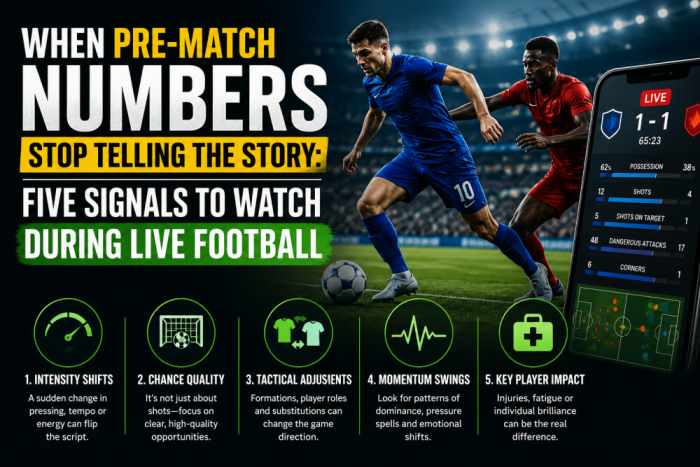
Pre-match analysis is built on assumptions. It assumes the expected players will start, both teams will use familiar tactics and the match will develop within a reasonable range of possible scenarios. Once the whistle blows, some of those assumptions can become outdated within minutes. A formation change, early booking or unexpected lack of intensity may alter the contest before the scoreboard moves.
Services presenting markets such as GemBet live odds allow these developments to be reflected during the match, but faster access to changing prices only helps when the viewer understands which events are genuinely significant. Reacting to every attack or dangerous-looking moment is not analysis. The challenge is separating meaningful changes from the normal noise of a football match.
Why the Pre-Match View Can Become Outdated
Before kick-off, a prediction may consider league position, recent form, injuries, home advantage and previous meetings. These factors remain useful, but they describe the teams before the specific match begins.
The actual contest introduces new information. A manager may choose a different formation from the one expected. A striker listed as fit may move cautiously after an early challenge. A team predicted to dominate possession may willingly allow its opponent to have the ball while protecting space near the penalty area.
Football is also highly influenced by game state. The team that scores first can become more defensive, while the opponent accepts greater risk. Possession, shots and territory after the goal may therefore say as much about the score as they do about the relative quality of the teams.
Good live analysis does not discard the pre-match view after five minutes. It updates that view as stronger evidence appears.
Signal One: A Genuine Change in Shape or Pressing
A formation graphic shown before kick-off is only a starting point. Teams change shape depending on whether they have the ball, where possession is lost and which opponent they are trying to contain.
A side listed in a 4-3-3 may defend in a compact 4-5-1. A full-back may move into midfield during possession, while a winger stays high to pin back the opposing defender. One striker may drop towards midfield and leave another player to attack the space behind the defence.
The important question is not whether a formation looks different on paper. It is whether the change affects how the two teams interact.
Several patterns deserve attention:
- One team can no longer play through the opponent’s first line of pressure.
- A midfielder is repeatedly receiving the ball without being challenged.
- A full-back is left isolated against two attackers.
- A high defensive line is being exposed by direct passes.
- A team expected to press aggressively is instead retreating into its own half.
These are more meaningful than one isolated attack. If the same advantage appears repeatedly, the original assessment of the match may need to change.
UEFA’s analysis of how teams start or resist periods of intense pressure shows how pressing, confidence and crowd energy can influence the opening of a match. Pressure is not simply a possession statistic. Its effect depends on where the ball is recovered and whether those recoveries create dangerous situations.
Viewers should still avoid assuming that every strong opening will continue for ninety minutes. Some teams deliberately begin at a high tempo before dropping deeper. The useful signal is not intensity alone, but whether the opponent has found a workable response.
Signal Two: Cards That Change How a Player Can Defend
A red card creates an obvious change because one team must continue with fewer players. The tactical effect can be immediate: a winger is removed, the midfield becomes narrower or the remaining striker is left isolated.
The impact of a yellow card is subtler but still important. A defender booked early may become less aggressive in duels because another caution would mean being sent off. An attacking player who repeatedly runs at that defender can then create an advantage without the card producing an immediate goal or chance.
The location and role of the booked player matter. A yellow card shown to a centre-forward for dissent may have little tactical significance. A booking for a defensive midfielder responsible for stopping counterattacks can affect how safely the team controls transitions.
The IFAB Laws of the Game establish that two cautions result in a sending-off. Players and coaches naturally adjust to that risk, although the degree of caution varies by individual and match situation.
When evaluating a card, ask:
- Which player received it?
- What defensive responsibility does that player have?
- Is the opponent actively targeting that area?
- Does the player have a history of making repeated challenges?
- Is a suitable replacement available?
A card should not produce an automatic reaction. Its value as a live signal comes from how it changes future behaviour.
Signal Three: Chance Quality, Not Just Shot Count
A live match page may show that one team has taken twelve shots while the other has managed only four. Without context, the first team appears dominant. Those twelve attempts might all have come from distance, while the opponent’s four included two clear chances from close range.
Shot count describes volume. It does not describe the probability that those shots become goals.
Expected goals, usually shortened to xG, attempts to estimate the likelihood of a shot being scored based on the circumstances in which it was taken. UEFA describes expected goals as a measure of shot quality using factors surrounding the attempt.
Even xG needs interpretation. A team can create one enormous chance and very little else. Another may repeatedly enter promising positions without completing the final pass required to register a shot. Different data providers can also produce slightly different xG figures.
When watching live, look for the process behind the number:
- Are shots coming from central or wide positions?
- Is the goalkeeper being forced into difficult saves?
- Are attackers reaching cutbacks near the penalty spot?
- Is the defence blocking shots comfortably?
- Are dangerous transitions developing before breaking down?
- Can the attacking team repeat the same route into the penalty area?
Repeated high-quality entries usually tell more than a sudden burst of low-probability attempts.
Signal Four: Substitutions That Change the Contest
A substitution should be evaluated by role, not reputation. Introducing a famous attacker does not automatically make the team more dangerous if the tactical problem lies elsewhere.
A manager might replace a winger with a central midfielder to gain control. A full-back may be introduced to allow another player to move higher. A striker who attacks space can completely alter a match previously played in front of the defence.
The reaction of the opposing team is equally important. If one manager changes shape, the other may respond immediately rather than wait for the new system to create a chance.
Useful questions include:
- Has the formation changed?
- Which player is now occupying the previously weak area?
- Does the substitute add pace, height, creativity or defensive control?
- Has a tired or booked player been removed?
- Is the team protecting the current score or trying to change it?
Timing provides context. An attacking substitution in the 55th minute may reflect a planned adjustment. Replacing a defender with a striker in the 88th minute is often a desperate response to the score and leaves little time for the change to work.
Substitutions can be strong signals, but they should be observed in action. The first few possessions after the change often reveal more than the name appearing on the touchline.
Signal Five: Fatigue, Conditions and the Match Clock
The same tactical plan becomes harder to execute as players tire. Pressing loses coordination, recovery runs slow down and spaces appear between midfield and defence. A team that looked comfortable for an hour can suddenly struggle to protect wide areas or second balls.
Fatigue is not determined by the clock alone. It can be influenced by:
- A demanding match played several days earlier
- Long-distance travel
- Heat and humidity
- A small number of available substitutes
- Chasing the ball for extended periods
- Playing with ten men
- Maintaining an unusually intense press
The key is to look for repeated physical signs rather than deciding that every team must tire after seventy minutes. Players may stop closing down at the same speed. Full-backs may take longer to recover. Clearances may begin returning directly to the opponent because the forwards can no longer hold up the ball.
Weather can intensify these effects, but it can also change the match in other ways. Heavy rain may slow the pitch or cause handling errors. Strong wind can disrupt long passes and crosses. Extreme heat may reduce the tempo from the beginning rather than create a dramatic late collapse.
The score also shapes fatigue. A leading team defending deep may appear exhausted because it no longer attacks, when it has consciously chosen to protect space. The difference becomes clearer by observing whether defenders still move together and whether the team can relieve pressure when it regains possession.
Signals That Often Look More Important Than They Are
Live football creates emotional moments that can feel predictive without offering much useful information.
Crowd noise
A loud home crowd can increase the sense that a goal is coming, but volume does not measure chance quality. The crowd may simply be responding to a tackle, corner or refereeing decision.
Possession without progression
A team can control the ball while the opponent comfortably protects the penalty area. Possession becomes significant when it moves defenders, creates overloads or leads to dangerous entries.
A single spectacular chance
One shot against the post can change the mood of a match, but it does not prove that similar chances will follow. Look for whether the opportunity came from a repeatable pattern or an individual mistake.
Corners in quick succession
Several corners can represent sustained pressure, but corners vary widely in quality. Some teams defend them comfortably, while others create genuine danger from well-rehearsed routines.
Recent goals in another match
What happens in one fixture has no direct effect on an unrelated game. Switching attention because another match suddenly becomes high-scoring is a form of chasing action, not analysis.
Live Odds React Too
The prices shown during a match already respond to many visible developments. Time passes, goals are scored, players are sent off and the market incorporates new information.
Seeing that one team has taken control does not necessarily mean the available odds have failed to notice. If the price has already shortened sharply, the new probability may be reflected before the viewer acts.
There is also a delay between observation and decision. By the time a dangerous pattern becomes obvious, the platform may have adjusted its markets or suspended them during an attack.
Live analysis should therefore not be treated as a race to react first. Speed without discipline encourages decisions based on adrenaline, especially immediately after a goal, missed chance or controversial incident.
Update the Prediction, but Keep the Same Standards
A useful live decision should still have a clear argument:
- What has changed since kick-off?
- Is it a repeated pattern or a single event?
- Does it genuinely alter the expected outcome?
- Have the available odds already reflected the change?
- Is there enough time left for the anticipated event to occur?
- Would the decision still make sense without the emotion of watching live?
If the argument cannot survive those questions, doing nothing may be the better response.
Pre-match numbers do not become useless once the game begins. They remain the baseline against which new evidence is judged. The strongest live signals are the ones that materially change that baseline: a tactical mismatch, a constrained defender, repeated high-quality chances, an effective substitution or visible physical decline.
Football will always produce false momentum, unexpected goals and performances that contradict both statistics and observation. No live signal guarantees what happens next. The goal is not to predict every swing in the match, but to recognise when the story on the pitch has genuinely moved beyond the one expected before kick-off.